
How to Decide Between Two Candidates as a Hiring Manager
Free Resources › Hiring
This article is for hiring managers who have two people they could offer the job to, and need a fair way to choose. It is not a guide for candidates comparing job offers.
The usual mess looks like this. Both finalists can do the work. One had a warmer interview. One has a tidier CV. Someone on the panel already has a favourite, and the discussion slides into “who did we like more?” That is how decent teams still make a hire they regret six weeks later.
The short version: go back to the role, score both people against the same criteria, and write the reason down before anyone leaves the room.
That is the same sequence as the Choosing the Right Candidate, Scorecard and Hiring Decision Models cards in The Hiring Leader's Toolkit, a 50-card deck for managers (4.6 from 16 reviews). Used by managers at Google, CVS, and Shopify. Over 9,000 decks sold, with a 30-day money-back guarantee.
The rule: compare each person to the role, not to each other
Start with the job you actually need done, not with a head-to-head.
Before you look at either name, write down:
- The two or three outcomes this person must deliver in the first year.
- The must-have criteria — the lines where a weak score is a no, even if everything else is strong.
- The nice-to-haves, which can break a tie but cannot rescue a miss on a must-have.
If you never wrote this down, you are not deciding between two candidates. You are inventing the job at the end of the process, usually in the shape of the person you enjoyed talking to. The Deciding What You Need card is the place to fix that, before you run another round.
Then score each finalist on their own interview scorecard, independently, before the panel talks. Only after both scorecards are filled in do you put them side by side.
A worked example: two finalists for an operations coordinator
Imagine you lead a six-person operations team and you are hiring a coordinator. The role has to keep a weekly planning meeting on track, chase updates from three other teams, and keep a simple tracker accurate. You marked three must-haves before interviews started:
- Prioritising when everything is “urgent”
- Working with people who do not report to them
- Owning a messy tracker or hand-over and making it reliable
Two people reach the final: Alex and Sam. Both are appointable. The panel is split.
Alex has six years in a similar industry. In the interview they described a quarter when a supplier slipped, they rebuilt the order list the same afternoon, and nothing reached the customer late. When asked about a week with too much work, they ranked by “whoever chased loudest that day” and could not say what they would drop if two senior requests landed at once. On working across teams, their examples were mostly their own manager making the introduction.
Sam has three years, in a different sector. Their tracker story was less polished: they inherited a sheet with 40 open items, sat with each owner for fifteen minutes, and cut it to a list of twelve with a named next step. It took three weeks, and they said so. On a clash between two senior requests, they asked both what “done” looked like that week, put the dates on the same page, and went back with one plan. Their industry knowledge is thinner, and they asked more basic questions about your tools.
A “who did we like?” conversation will often pick Alex. A scorecard conversation often picks Sam, or at least makes the trade-off visible.
How the two scorecards compare
Each interviewer scored only the lines they owned, from 1 (poor) to 5 (outstanding), with a sentence of evidence. Combined for the debrief, the must-haves looked like this:
| Must-have | What “good” looks like | Alex | Sam | The evidence, in short |
|---|---|---|---|---|
| Prioritising | Has a rule for what gets attention, and can tell someone what will slip | 2 | 4 | Alex: ranked by who chased. Sam: put both requests on one page and went back with a plan. |
| Working across teams | Gets help from people they do not manage, without escalating first every time | 3 | 4 | Alex: manager made the introductions. Sam: sat with each owner and left with a next step. |
| Owning a messy tracker | Turns an unreliable list into something the team actually uses | 4 | 4 | Both have done this. Alex was faster; Sam was more explicit about what was still messy. |
| Industry knowledge (nice-to-have) | Can learn our context without a long ramp | 5 | 2 | Alex has the sector. Sam does not, and will need more support in month one. |
Alex is not a poor candidate. They are stronger on industry knowledge, which you did not mark as a must-have. Sam is stronger on the two must-haves that decide whether this hire will work in your team. If you hire Alex because the industry background feels safer, you should at least know you are trading away the thing you said mattered most.
A one-page comparison template
Copy this into a doc or a sheet. Fill it after both scorecards are in, not during the interviews.
Role:
Date:
Hiring manager:
Must-haves (do not change these now): 1. 2. 3.
Nice-to-haves:
| Criterion (must-have?) | Weight if you use one | Candidate A score and one line of evidence | Candidate B score and one line of evidence | Who is stronger, and why |
|---|---|---|---|---|
Must-haves met? A: yes / no B: yes / no
Open questions still to close (a reference, a work sample, a follow-up on one criterion):
Decision: offer to ____ / neither / need one more piece of evidence, owned by ____, by ____
The reason, in three sentences, tied to the must-haves:
Risk we are accepting, and how we will manage it:
If you want the criteria and the 1–5 anchors already written out, use the interview scorecard template for each person, then paste the must-have lines into this comparison.
What to do when the scores are tied
A tie is common. It does not mean you should take the warmer interview, or average the panel into a polite draw. Pick one of these, in this order, and agree it before you look at the names:
- Go back to the highest-weighted must-have. If one person is clearly stronger on the outcome that matters most this year, that is the decision. Write it down.
- Close one open question, the same way for both. A short work sample, a second conversation on the weak line, or a structured reference check aimed at that criterion. Do not invent a new test for only one of them.
- Ask what you would be coaching in the first 90 days. The better hire is often the one whose gap you have the time and skill to support. A gap you cannot coach — for example, they cannot work across teams and you have no time to sit in with them — is a reason to say no, even if the other scores look even.
- Do not hire if neither person meets a must-have. The Choosing the Right Candidate card puts this plainly: it is not a race, and it is not a democracy. Re-open the search, or go back to Don’t Hire, Optimise, rather than filling the seat because you are tired of interviewing.
What not to use as the tie-breaker: who you would rather be stuck with at an airport, who “feels like a fit”, or who the most senior person in the room prefers. Those can be useful as a final sense-check once the evidence is on the table. They are a poor substitute for it. The Cognitive Biases and Trust Your Intuition cards are there to help you notice that pull, not to let it run the meeting.
How to run the 20-minute decision conversation
This is a short version of the interview debrief. If you want the full agenda and the questions to ask in the room, use the interview debrief guide for hiring managers.
- Collect every scorecard before anyone speaks. Late scorecards wait outside the decision.
- The most junior interviewer goes first. If the hiring manager or the most senior voice starts, it becomes everyone’s opinion.
- Walk the must-haves one at a time. Read the evidence, not the verdict. A rating only changes if someone can point to new evidence.
- Only then look at the side-by-side comparison.
- Write the decision, the reason, and the risk you are accepting before people stand up.
If the conversation turns into advocacy — “I just think Alex is more senior” — put the comment against a line on the scorecard. If it does not fit a line, it is not part of this decision.
After you decide
Tell the person you are offering first, then the person you are not, without leaving the second one waiting for days. Keep the reason job-related and consistent with the scorecards. You do not need to read them the comparison table; you do need to be able to stand behind it if they ask why.
If you accepted a risk — Sam will need a tighter briefing on your industry, or Alex will need closer coaching on how to say no to competing requests — put that in the first-week plan. A decision record that never reaches how you will manage the person is only half-finished.
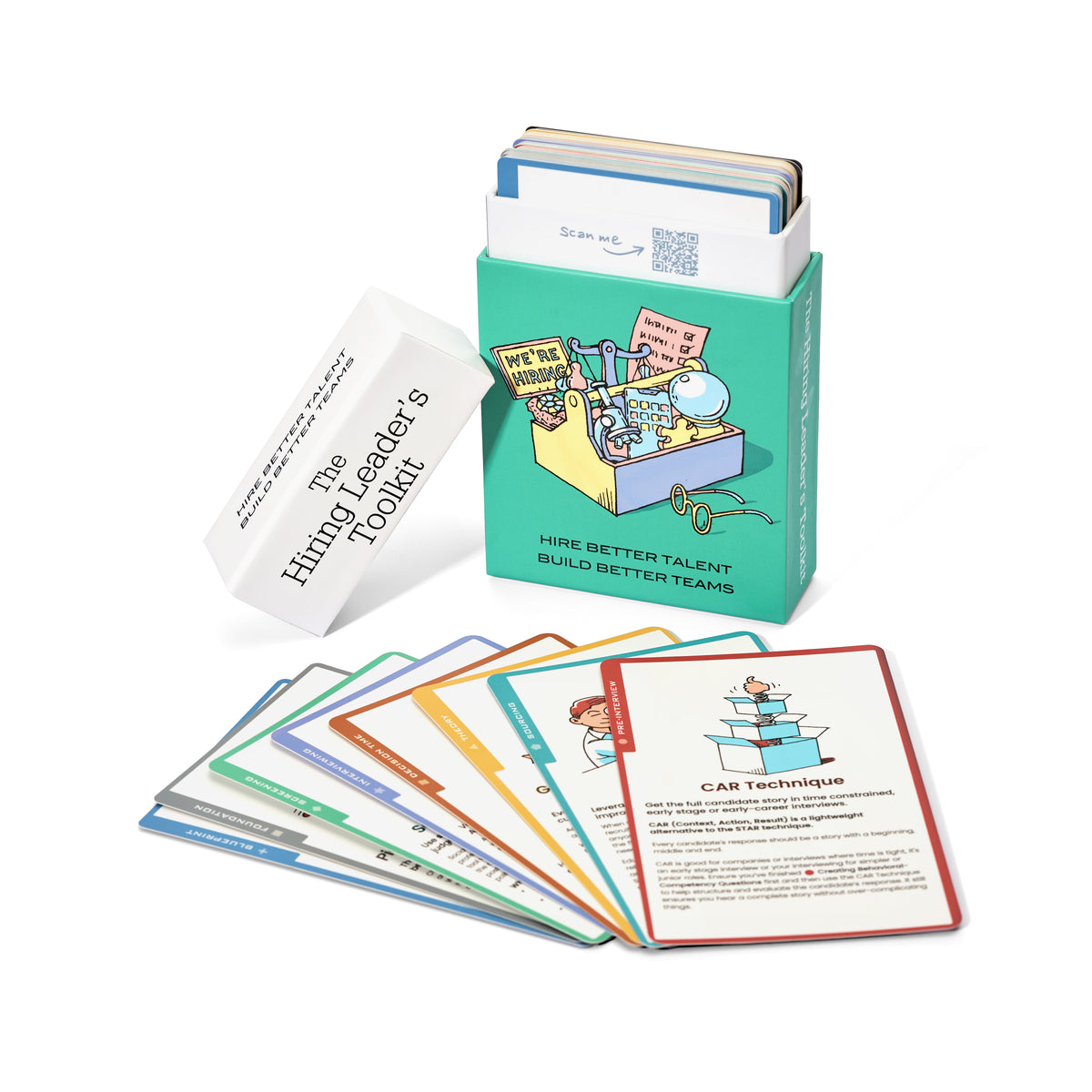
Choosing the Right Candidate is one step in The Hiring Leader's Toolkit
The Hiring Leader's Toolkit is a step-by-step card system for hiring managers: defining roles and responsibilities, choosing competencies and traits, writing behavioural questions, probing with STAR and CAR, scoring on a shared scorecard and running the hiring decision.
Get The Hiring Leader's ToolkitBrowse all free toolsIf you want this process on cards you can hand the panel, The Hiring Leader's Toolkit walks through Choosing the Right Candidate, the Scorecard, Hiring Decision Models, Raising The Bar and the Feedback Session. 4.6 from 16 reviews, 50 cards, printed plus digital. 30-day money-back guarantee.
If you also want the leadership and team-conversation decks, The Complete Manager's Kit brings all three together, printed plus online access. Save about 28% compared with buying them separately.
Tools that work well with this one
FAQs
How do you decide between two equally qualified candidates?
Score both against the same must-haves, not against each other. If they still look even, use a pre-agreed tie-breaker: the highest-weighted criterion, the same short work sample or reference question for both, or which gap you can actually coach. Write the reason down. Do not use “we liked them more” as the reason.
What if the panel disagrees?
Disagreement is useful if it is about evidence. Have each interviewer read the note behind their score. A rating can change only when new evidence appears. If one person is scoring a nice-to-have as if it were a must-have, go back to the criteria you agreed before interviews.
Should I run another interview when I cannot choose?
Only if you know which criterion is still untested. A vague “one more chat” usually rewards the stronger performer in conversation, not the stronger fit for the work. Prefer a focused follow-up, a work sample, or a reference question aimed at the open line.
Is it fair to hire the person with less experience?
Yes, if they are stronger on the must-haves for this role. Years in the sector are only a must-have if you marked them as one before you met anyone. If you change that now, you are changing the job.
What if neither candidate is right?
Do not offer the job. Reopen the search, or question whether you need to hire at all. A tired “we have to pick one” is how must-haves get dropped.
How do I tell the person I am not hiring?
Promptly, clearly, and without blaming the other finalist. Stick to the role and the criteria. If you can offer a useful, honest line of feedback that matches the scorecard, do; if you cannot do it without inventing a reason, keep it short and courteous.