
How to Run an Interview Debrief as a Hiring Manager
Free Resources › Hiring
This article is for hiring managers and interview panels who need to compare notes after interviews and decide whether to advance, reject, or get one more piece of evidence. It is not a self-debrief for candidates, and it is not a guide to following up after your own job interview.
A debrief is a short, structured meeting. Each interviewer arrives with a completed scorecard. You walk the criteria, not the personalities. You leave with a decision written down. When it is skipped, or run as a “so, what did we think?”, the loudest person in the room hires their favourite, and the notes never quite match what anyone said in the hallway.
The Feedback Session, Scorecard, Taking Notes and Choosing the Right Candidate cards in The Hiring Leader's Toolkit are built for this meeting. 50 cards, 4.6 from 16 reviews. Used by managers at Google, CVS, and Shopify. Over 9,000 decks sold, with a 30-day money-back guarantee.
What an interview debrief is — and what it is not
It is a decision meeting for the people who interviewed the candidate. The hiring manager (or a nominated lead) runs it. Every interviewer who met the person should either be in the room or have sent a completed scorecard in advance.
It is not:
- A recap of how the candidate felt about the interview, or a prep session for someone who just interviewed for a job.
- A vote. The aim is a standards-based decision, not an average of first impressions.
- A place to fill in your scorecard. If your scores are still blank, you are not ready to debrief.
Do it while the interviews are still fresh: the same day if you can, and within 24 hours at the outside. Leave at least a few minutes after the last interview so people can finish their notes alone. The Scorecard card asks you to log the score and the rationale within three minutes of the interview ending, before you talk to anyone else. That rule is what makes the debrief honest.
Before the meeting: four things that have to be true
- The criteria were agreed before the first interview. If the panel is still arguing about what the job needs, stop and go back to Deciding What You Need. You cannot debrief against a moving target.
- Every interviewer has the same interview scorecard, with the same 1–5 anchors and the same must-haves marked.
- Scorecards are submitted before the meeting starts. People who have not submitted can join once they have. A verbal “I thought they were great” is not a scorecard.
- Someone is nominated to facilitate and to write the decision record. On a small panel, that can be the hiring manager. On a larger one, it helps if it is not the person who already has a favourite.
A 25-minute debrief agenda
Use this as a script. It is long enough to hear the evidence and short enough that people will actually attend.
Debrief: [candidate] for [role]
Attendees: [interviewers], [hiring manager], [facilitator]
Decision we are making today: advance to offer / advance to a further stage / reject / get one more piece of evidence
| Time | What happens |
|---|---|
| 0:00–0:02 | The facilitator reads the must-haves and the rating scale out loud. Reminder: evidence first, recommendations last, hiring manager last. |
| 0:02–0:05 | Silent read of the scores. No commentary yet. |
| 0:05–0:18 | Walk each criterion. The interviewer who owned it reads their evidence and rating. Others may add evidence only. If two scores are two or more points apart, both people read their notes, then you resolve. A rating changes only when someone names new evidence. |
| 0:18–0:22 | Must-haves and risks. For each must-have: met, not met, or not assessed. What risk would you be accepting if you advanced this person? |
| 0:22–0:24 | Recommendations, most junior first, hiring manager last. One sentence each, pointing at the ratings. |
| 0:24–0:25 | Decision and record. Decision, who decided, next step, owner, date. Write it before anyone leaves. |
If you have two finalists and the decision is which of them to offer, use this agenda once per person, then move to the side-by-side comparison. Do not start with “so who do we prefer?”
Questions to ask in the room
Ask these about the candidate in front of you, against the role, not against whoever came in yesterday.
- Where is the strongest evidence, and which criterion does it sit on? Ask for the example, not the adjective.
- Where is the weakest evidence? Is that a must-have? A 2 on a nice-to-have is a coaching plan. A 2 on a must-have is a no, or a clearly scoped follow-up.
- What did we not test? If nobody can score “stakeholder management”, the gap is in the interview plan, and you should not invent a score for it now.
- Can the risks be coached, supported, or checked with a reference? If yes, say who would do that, and whether you actually have the time.
- Would you hire this person for this role, on this evidence? A clear yes, no, or “not yet — I need X”. “I liked them” is not an answer.
- If we say yes, what are we accepting, and what happens in week one? A debrief that never reaches this point is only a vibe check.
What not to ask: “Who would you rather grab a coffee with?”, “Do they feel like a fit?”, or “Who did we like more than the other one?” Those questions skip the scorecard. If chemistry or values matter, they should already be on the card as a defined behaviour, not as a late free vote. The Cognitive Biases card is there for this moment.
A one-page debrief record
Copy this into a doc, a form, or the notes field in your hiring tool. Fill it at the end of the meeting.
INTERVIEW DEBRIEF RECORD
Candidate:                 Role:
Date:                      Facilitator:
Interviewers present:
Absent (scorecard used):
All scorecards in before the meeting:  yes / no — who was late:

DECISION:  advance to offer / advance to next stage / reject / more information needed
Decided by:
If more information: what evidence, how, owner, decide by:

Must-haves
- [Must-have 1]: met / not met / not assessed. Evidence:
- [Must-have 2]: met / not met / not assessed. Evidence:
- [Must-have 3]: met / not met / not assessed. Evidence:

Ratings (interviewer scores, then the team's view)
- [Criterion]:  [A: 3, B: 4], team view:
- [Criterion]:
- [Criterion]:

Main reasons (job-related, pointing to evidence)
1.
2.

Risks accepted, and how we will manage them:
Ratings changed in the meeting (old, new, the new evidence):
Dissent (who, which criterion, their evidence):
Next step, owner, date:
Store it with the scorecards. In six months, this is the only part anyone will read.
A short example: the debrief that goes wrong, and the one that works
You have just interviewed Jordan for the operations coordinator role. Three people met them: you (the hiring manager), Priya from the team, and your director, who joined the last 20 minutes.
The meeting that does not work. The director starts: “I really liked Jordan. Let’s offer.” Priya, who spent 45 minutes on the tracker and the planning meeting, goes quiet. You never hear that Jordan could not explain how they would handle two senior requests on the same afternoon. The offer goes out the same day. The planning meeting is still a mess in month two.
The meeting that works. Scorecards are in before you start. Priya goes first, on the criteria she owned. She scores a 2 on prioritising, with the note: “When I asked about two urgent requests, they said they would ‘just get both done’. No rule for what slips, and no example of having told someone no.” You have a 4 on the tracker, with a clear example. The director, who only saw the last 20 minutes, has a 5 on “overall impression” and no notes on prioritising, because they did not test it. You do not average the 2 and the 5. You mark prioritising as a must-have that was not met, or you send a focused follow-up on that one line. The record shows the dissent and the reason. That is a debrief.
Common mistakes
- Starting with a verdict. “I think we should hire them” closes the evidence before it is heard. Recommendations come last.
- Letting the most senior person speak first. They will, unless you set a different order.
- Averaging a deal-breaker. A 1 or 2 on a must-have is not fixed by high scores elsewhere.
- Scoring a criterion nobody tested. Leave it blank and, if it is a must-have, go and test it.
- Changing the criteria mid-debrief. If you suddenly decide “industry experience” is essential, you are no longer assessing this interview. You are redesigning the job. Take that back to Deciding What You Need, and be honest that earlier candidates were judged against something else.
- Skipping the written record. A decision that lives only in the chat will be retold differently by Friday.
After the debrief
If you are advancing to an offer, close any last reference check question that the record asked for, then move. If you are choosing between two finalists, take the two records into the comparison template. If you are rejecting, tell the person promptly, with a reason you can stand behind.
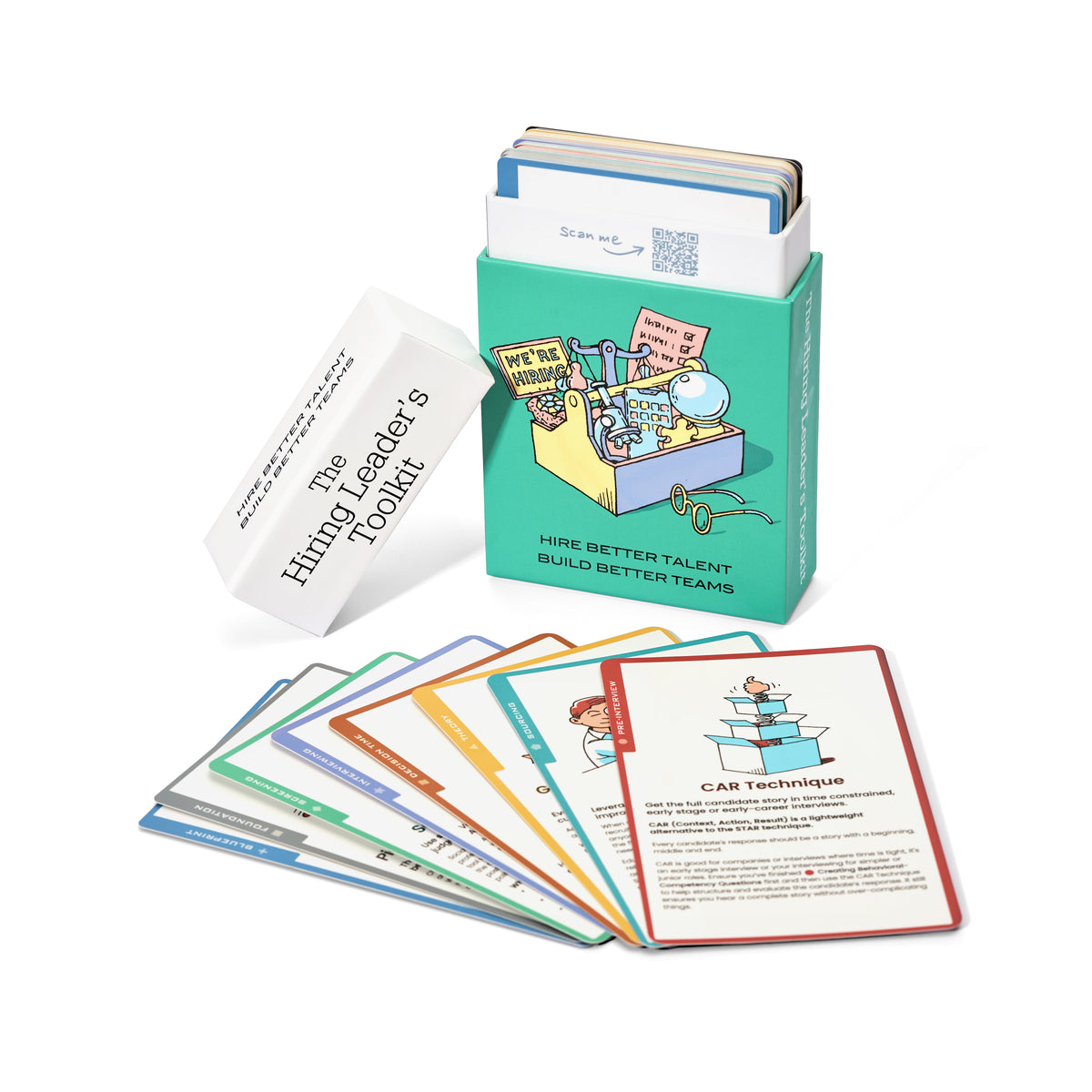
The debrief is one step in The Hiring Leader's Toolkit
The Hiring Leader's Toolkit is a step-by-step card system for hiring managers: defining roles and responsibilities, choosing competencies and traits, writing behavioural questions, probing with STAR and CAR, scoring on a shared scorecard and running the hiring decision.
Get The Hiring Leader's ToolkitBrowse all free toolsIf you want the scorecard, the debrief questions and the decision models in one place, The Hiring Leader's Toolkit is the 50-card deck for this. 4.6 from 16 reviews, printed plus digital, 30-day money-back guarantee.
If you also want the leadership and team-conversation decks, The Complete Manager's Kit brings all three together, printed plus online access. Save about 28% compared with buying them separately.
Tools that work well with this one
FAQs
What is an interview debrief for a hiring manager?
A short meeting, after the interviews, where the panel reviews scorecards, walks the criteria, and records a decision: advance, reject, or get one more piece of evidence. It is for the people who interviewed the candidate, not for the candidate reviewing their own performance.
When should you debrief after an interview?
As soon as the scorecards are in, ideally the same day, and within 24 hours. Leave a short gap after the last interview so each interviewer can finish their notes alone.
Should interviewers share their scores before the debrief?
They should submit them to the facilitator before the meeting, independently. They should not compare notes or agree a score in the corridor first. The point of the meeting is to hear the evidence, not to ratify a pre-agreed verdict.
What questions should hiring managers ask in an interview debrief?
Ask where the strongest and weakest evidence sits, whether a weak score is on a must-have, what you failed to test, whether a risk can be coached or checked, and whether you would hire this person for this role on this evidence. Then write down what you are accepting if you say yes.
Who should make the final decision?
The hiring manager, after hearing the evidence. It is not a majority vote, and a more senior guest interviewer should not override a must-have that was missed just because they enjoyed the conversation. If your organisation uses an independent reviewer to keep the standard honest, they should be looking at the same scorecard, not at a private test.
What if an interviewer did not fill in a scorecard?
Do not start. Give them a few minutes to complete it from their notes, or use their written scorecard if they cannot attend. A debrief built on one person’s memory is not a debrief.